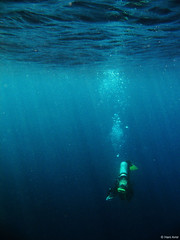
Earth's atmosphere is composed of a mixture of gasses that obey the famous chemistry "Gas Laws." Some of these laws become matters of life and death when using a Self Contained Underwater Breathing Apparatus (SCUBA) device. Understanding just four of these laws will help you stay alive and out of trouble while SCUBA diving.
Boyle's Law
For SCUBA divers, the most important of the gas laws--and the most deadly one to ignore--is Boyle's law. Boyle's law says that as long as temperature is constant, pressure and volume are inversely proportional--when one goes up the other goes down and vice versa. If you have an inflatable container--such as your lungs-- decreasing the pressure increases the volume. So if you take a deep breath and then move toward the surface while holding your breath, your lungs expand. If you hold it too long your lungs will explode. This is why you should never hold your breath while SCUBA diving--not even briefly. If you breathe consistently the volume of air in your lungs will constantly adjust to the changing pressure.
Amonton's Law
Amonton's law says that if the volume of a gas is constant--as it is in a SCUBA tank--the pressure and temperature are directly proportional. If one increases so does the other, and vice versa. If you fill up your tank on a summer day and then jump in water that's 40 degrees cooler, you are going to have less pressure than you might think. Therefore, the tank will not last as long. If you fill up a tank and then put it in the trunk of the car where it is 60 degrees hotter, the pressure might rise to dangerous levels and damage your equipment.
Henry's Law
Henry's law describes how pressure determines a liquid's ability to absorb gasses. As pressure increases, more of a gas will dissolve in a liquid. When a diver dives, the pressure increases and more gasses dissolve in the diver's tissues. Most of Earth's atmosphere is nitrogen, which is relatively inert so it does no real harm. If the diver ascends slowly the nitrogen comes out of the tissues as the pressure decreases. If the diver with nitrogen-saturated tissues (too deep, too long) ascends too quickly, the nitrogen comes out too fast--in bubbles. This causes a very dangerous condition known as the "bends," which can cause permanent damage or even death.
Dalton's Law
Dalton's law says that if a gas is a mixture, the pressure of each component depends on the percentage of that component in the mixture. Earth's atmosphere is about 78% nitrogen, 21% oxygen, and one or two percent other gasses--depending on where you live. If your tank is filled using faulty equipment, you might be getting a lethal dose of something that is relatively safe at low pressures. Even oxygen can be toxic at high pressures. Nitrogen at high pressures can have a narcotic effect (known as "rapture of the deep") that can cause a deadly loss of judgement.
By Carlos Mano, eHow Contributor
Kathy Dowsett
www.kirkscubagear.com
Showing posts with label breathing underwater. Show all posts
Thursday, January 2, 2014
SCUBA Gas Laws
Labels:
Amonton's Law,
Boyle's Law,
breathing underwater,
Dalton's Law,
dive regulators,
dive tanks,
gas laws,
Henry's Law,
kirkscubagear,
life and death,
lungs,
pressure,
scuba diving,
scuba tanks
Wednesday, November 28, 2012
5 Diving Tips for Saving Air
Diving Tips: Saving Air
Do you breathe your tank down faster than your buddy? Here are 5 diving tips to help conserve your oxygen and extend your bottom time.
1. Fix the small leaks
Even a tiny stream of bubbles from an O-ring or an inflator swivel adds up over 40 minutes, and may be a sign of more serious trouble ahead anyway. A mask that doesn't seal is another kind of leak in that you have to constantly blow air into it to clear out the water. It's also a source of stress, which needlessly elevates your breathing rate and thereby reduces your breathing efficiency. Does your octo free-flow easily? That can dump a lot of air quickly. Detune it or mount it carefully so the mouthpiece points downward.
2. Dive More
Inexperienced divers are famous for burning through their air supply at a furious rate, so one of the best diving tips for saving air is to simply dive more often. You may not be a new diver, but unless you dive almost every week it's still an unnatural activity. By diving more, your body will get used to the idea, and you'll breathe less.
3. Swim Slowly
The energy cost of speed is even more than you might think: Swim half as fast as you do now, and you'll use less air.
4. Stay Shallow
Because your regulator has to deliver air at the same pressure as the water, a lungful at 33 feet (two atmospheres) takes twice as much out of your tank as does the same breath at the surface. At 99 feet (four atmospheres) it takes twice as much as at 33 feet. There's absolutely nothing you can do about that except to avoid being deeper than you have to be. If you're making a transit over an uninteresting sand flat to get to the edge of the drop-off, do it at 15 feet instead of at 40 feet, and you'll save air.
5. Minimize the Lead
If you're overweighted, you have to put more air into your BC to float it and be neutral. The inflated BC is larger and requires more energy and oxygen to push it through the water. An extra eight pounds of lead means your BC is one gallon bigger when inflated enough to make you neutral.
Thanks to Scuba Diving----an informational scuba blog.
Kathy Dowsett
www.kirkscubagear.com
Do you breathe your tank down faster than your buddy? Here are 5 diving tips to help conserve your oxygen and extend your bottom time.
1. Fix the small leaks
Even a tiny stream of bubbles from an O-ring or an inflator swivel adds up over 40 minutes, and may be a sign of more serious trouble ahead anyway. A mask that doesn't seal is another kind of leak in that you have to constantly blow air into it to clear out the water. It's also a source of stress, which needlessly elevates your breathing rate and thereby reduces your breathing efficiency. Does your octo free-flow easily? That can dump a lot of air quickly. Detune it or mount it carefully so the mouthpiece points downward.
2. Dive More
Inexperienced divers are famous for burning through their air supply at a furious rate, so one of the best diving tips for saving air is to simply dive more often. You may not be a new diver, but unless you dive almost every week it's still an unnatural activity. By diving more, your body will get used to the idea, and you'll breathe less.
3. Swim Slowly
The energy cost of speed is even more than you might think: Swim half as fast as you do now, and you'll use less air.
4. Stay Shallow
Because your regulator has to deliver air at the same pressure as the water, a lungful at 33 feet (two atmospheres) takes twice as much out of your tank as does the same breath at the surface. At 99 feet (four atmospheres) it takes twice as much as at 33 feet. There's absolutely nothing you can do about that except to avoid being deeper than you have to be. If you're making a transit over an uninteresting sand flat to get to the edge of the drop-off, do it at 15 feet instead of at 40 feet, and you'll save air.
5. Minimize the Lead
If you're overweighted, you have to put more air into your BC to float it and be neutral. The inflated BC is larger and requires more energy and oxygen to push it through the water. An extra eight pounds of lead means your BC is one gallon bigger when inflated enough to make you neutral.
Thanks to Scuba Diving----an informational scuba blog.
Kathy Dowsett
www.kirkscubagear.com
Labels:
air leaks,
breathing underwater,
dive masks,
dive tanks,
diving,
diving tips. saving air,
o rings,
regulators,
saving air,
scuba diving,
Scuba Scoop,
tanks,
using less air,
weights,
weights when diving
Thursday, March 29, 2012
The Beauty of the Dive
Scuba diver. Found at Plongée sous-marine & obt'd Image:Plongeur bouteilles.jpg id'd there as (Photo credit: Wikipedia)
Diving on a shipwreck, I look up while inside a cabin and see a pool of air from my exhaled bubbles. The pool shimmers, mirror-like, and for a moment I see my own image gazing back at me. I make a face at my reflection and breathe out. The exhaled air hits a different part of the ceiling. Large bubbles burst into a thousand tiny particles upon impact, and then slither like quicksilver up to the larger pool. Magic!
I am obsessed with scuba diving. How do I love diving? Let me count the ways:
1. I love the descent. The moment I deflate my buoyancy compensator and slip below the surface, the physics of my environment changes. I am in free fall. I am in control. I love to stretch my arms out and swoop down to the reef like a bird. When I am not with students, I descend as fast as I can equalize my ears. The speed of the water rushing past me gives me a high. I come to a perfectly controlled arrest, stopping a few feet above the reef in an effortless hover. It's like sky diving, but without the possible splat.
2. I love the surface. A good portion of my dive is spent looking up. The surface roils like some foreign atmosphere above my head. I like seeing waves upside down - little bubbles of air are trapped below the surface and sparkle in the light. On a clear day, I can see clouds, birds, and the diffused yellow circle of the sun. Looking at the surface keeps me aware of the vastness and power of the ocean. It makes me feel insignificant and secure at the same time. I am a miniscule being tucked comfortably beneath a blanket of water.
3. I love the silence. The terrestrial world is cacophonous. Until I get underwater I have to endure the rattle of the boat engines and the static-y white noise of the wind on my ears. Below the surface the upstairs world fades away. With the exception of the rush of my bubbles and an occasional crunch as a parrotfish takes a bite of coral, the environment is completely silent. I am only forty feet below the everyday world, but I might as well be light years away. For a short period of time, I am alone with my thoughts and at peace.
4. I love the sunlight on sand. On a bright day with clear water, rays of light shine all the way to the ocean floor. I am hypnotized by the playful antics of light beams on white sand. During their journey through the water, the rays break into little squirming rainbows which remind me of a psychedelic screen saver. I have spent whole dives ignoring turtles to staring intently at these dancing, shining bits of wonderful.
5. I love the sense of adventure. Even if I am swimming over a reef that I have visited a thousand times, I still have the sense that I am sneaking around a new and almost forbidden place. I could peek around a coral head and find a shark or unexpected seahorse. Every dive is different and I always feel a little bit like Jacques Cousteau underwater.
6. I love divers. Scuba diving makes me feel like I am part of a special, exclusive club. My friend Denise McDonald explained it well, "We all have our own secret language, hand signs and meeting places." Scuba divers share an admiration of the underwater world that few non-divers can understand. I have a sense of belonging - similar to being part of a secret society or a community of like-minded individuals.
Thanks to Natalie Gibb:::About.com
Kathy Dowsett
www.kirkscubagear.com
Thursday, December 1, 2011
4 Effective Strategies In Preserving Air While Underwater
Air consumption is very important for your diving success.The longer you last underwater, the more air is required from you. If you have just started your scuba diving lessons and conserving air while underwater is one of your main problem, there are some simple steps you can take to perfect your breathing technique and last longer underwater.
1. Increse your diving routine. This might sound like a cliche, but definitely you really have to learn to be comfortable with water. Find time to dive more to be totally comfortable with water. Diving most often will help you relax your muscles while in the water. Ever notice how your air consumption have dramatically decreased since the first time you dive to your recent dive? I bet you have observed a decrease in you air consumption. This is so because your body was able to finally compensate to your air requirements while underwater and relaxes your muscle.
2. Practice deep and slow breathing. Short and shallow breaths will make you lose air more easily. Breathe deeply and then slowly exhale. Avoid holding your breath just to decrease your air consumption. You will only retract your diaphragm, which increases your air consumption which could lead to physical exhaustion while underwater. So avoid holding your breath if you want to last longer in water.
3. Avoid any unnecessary movements while underwater. When diving, avoid moving too often. Use your fins when moving. The more you move the more air you will consume. Place your hands either at your side or in front of you. Actually, it can be any position you would feel comfortable to.
4. Check your gear setup. Before you go on diving, make sure you don’t have anything hanging loosely on your gear. Anything that hangs loosely on your gear will create a dragging movement while underwater and will definitely increase your air consumption. Always get rid of those unused scuba accessories just before you go out for diving.
Thanks to Simply Scuba
Kathy Dowsett
www.kirkscubagear.com
1. Increse your diving routine. This might sound like a cliche, but definitely you really have to learn to be comfortable with water. Find time to dive more to be totally comfortable with water. Diving most often will help you relax your muscles while in the water. Ever notice how your air consumption have dramatically decreased since the first time you dive to your recent dive? I bet you have observed a decrease in you air consumption. This is so because your body was able to finally compensate to your air requirements while underwater and relaxes your muscle.
2. Practice deep and slow breathing. Short and shallow breaths will make you lose air more easily. Breathe deeply and then slowly exhale. Avoid holding your breath just to decrease your air consumption. You will only retract your diaphragm, which increases your air consumption which could lead to physical exhaustion while underwater. So avoid holding your breath if you want to last longer in water.
3. Avoid any unnecessary movements while underwater. When diving, avoid moving too often. Use your fins when moving. The more you move the more air you will consume. Place your hands either at your side or in front of you. Actually, it can be any position you would feel comfortable to.
4. Check your gear setup. Before you go on diving, make sure you don’t have anything hanging loosely on your gear. Anything that hangs loosely on your gear will create a dragging movement while underwater and will definitely increase your air consumption. Always get rid of those unused scuba accessories just before you go out for diving.
Thanks to Simply Scuba
Kathy Dowsett
www.kirkscubagear.com
Wednesday, June 8, 2011
How to Breathe Efficiently When Scuba Diving
Image by hppyhntr via Flickr
Understand that oxygen converts to carbon dioxide only inside the lungs.
Know that everything else the throat, mouth and nose is dead-air space.
Realize that snorkels and scuba regulators increase the length of normal dead-air spaces.
Breathe deeply while diving, in order to flush out dead air and bring fresh oxygen into the lungs.
Inhale slowly (with your tongue at the roof of your mouth, like a splash guard) in case water has entered the snorkel or regulator.
Never hold your breath; trapped air will expand as you ascend.
If you begin to choke, hold the regulator with one hand and cough or spit into it as much as necessary; the regulator can handle it. Just don't panic.
Thanks to eHow
Kathy Dowsett
www.kirkscubagear.com
Related articles
Saturday, October 16, 2010
Want to Learn Great Buoyancy Control?
Image via Wikipedia
The Buoyancy Paradox
One of my former instructors once told me, “Slow is smooth and smooth is fast.” I never really knew what that meant, until I started to slow down my actions while under water. Once I started to move slower, I quickly realized that I was actually moving more efficiently than before. My movement became more deliberate. This deliberate movement allowed me to gain more control of myself while under water. The lack of useless movement allowed me to sit still. My hand and feet movement decreased and I was able to hover in a fixed position without swimming all over the place.
You’ll be surprised just how much small hand movements will move you around. Think of your hands as small oars on a boat. When you wave your hands around even the slightest, you’ll create resistance in the water. This is a tiny bit of propulsion. Combine this with foot/fin movement, you’ll move all over the place when trying to hover. The best thing to do when learning how to control your body movements while underwater is to simply grab yourself (no, not there). Fold your arms and hold onto your elbows. You can also extend your arms and hold your wrists. This is actually preferred as it puts your body into a stretched out position and allows you to remain in trim. Holding your hands like this will also help keep you from rolling to the left or right. It will square your shoulders and make difficult rolling.
Try swimming with your hands held out in front of you. It will force you to put more focus on propelling yourself with your feet. Then you’ll start to realize that you are swimming to fast and can start to develop those swimmer’s legs. That is, you’ll start to control your leg movement. Once you can minimize your hand and feet movement, you’ll start to stay put and can focus on using your breathing to control your movement up or down in the water column.
Give it a try. Make slow and deliberate movements and see how your buoyancy control improves.
Thanks to Duane of Precision Diving
Kathy Dowsett
www.kirkscubagear.com
Related articles
- Mystery of the Floating Octopus Solved (livescience.com)
- Longreach Buoyancy Deployment System wins 2010 James Dyson Award (ecofriend.org)
- Carolyn Chan: Immersed Senses Lets Scuba Diver Breathe And Move Freely Underwater - The Design blog (thedesignblog.org)
Friday, July 30, 2010
Mares Diving to Sponsor Members of USA Spearfishing Team
Image via Wikipedia
The company, which produces equipment ideally-suited for spearfishing and competitions, will immediately get behind Justin Allen, Sean Moreschi and John Modica as the trio continue their preparations for the World Spearfishing Championships scheduled for Mali Losinj, Croatia in September.
According to Steve Lamphear, General Manager, Mares Diving, it’s a natural fit for Mares to sponsor these competitors. “Each of these incredible athletes has the skill, experience and ability to bring home a title for the US team. Mares is pleased to be associated with them as we get closer to the World Championships this September.”
The competitors include:
Justin Allen: The native of Pembroke, Massachusetts was the 2009 National Team Champion and the 2008 Individual National Champion. Of his place of the team, he says, It’s truly an honor representing Team USA in the greatest sport in the world and I couldn’t be happier with the talented, dedicated team we have. I’m looking forward to making the most of this adventure and remaining a presence in the spearfishing community as a competitor and promoter of the sport for many years to come.”
Sean Moreschi: The 24-year old from Charleston, Rhode Island has competed in two US National Championships and spends the winter months training and competing in Florida. After having traveled all over the world free diving and spearfishing, Moreschi says, “with over a decade of surreal experiences while diving, it is still my primary passion. Spearfishing is no longer a hobby for me. It is a way of life.”
John Modica: From Pomfret, Connecticut, Modica is the alternate for the 2010 USA Team. A competitor since his early teens, John has participated in two US National competitions. Of his passion for the sport, he says, “I didn’t consider taking competition to the next level until another local diver told my group that it would open opportunities to meet other divers, explore new waters, and gain recognition for our skills. A few months later we participated in and won the 2008 U.S. Spearfishing Nationals at Kings Beach, Newport, Rhode Island.”
About the World Spearfishing Championship: The Worlds are a 2-day championship where divers harvest fish for about 7 hours per day. Each day, the diving is done at a different location. Typically, 20-25 teams qualify to compete at the World Championships. And because too many teams want to participate at the Worlds, sometimes there are regional qualifiers for the World Championships per Continent. The America’s Qualifier is the Pan-American Spearfishing Championship lastly hosted at Isla Margarita, Venezuela in November 2009 for the 2010 Worlds.
The World Championships are boat-based meets and each team is allowed to have three divers hunting. The Championships are run somewhat like a mini-Olympics where there are opening ceremonies and a big closing banquet. It is not uncommon for thousands of people to attend the opening ceremony where each team has their own national uniform. At the opening event there is a parade of Nations where each country carries their nations’ flag.
Mares products available @ www.kirkscubagear.com
Kathy Dowsett
www.kirkscubagear.com
Related articles by Zemanta
- Diver dies spearfishing north of Darwin (news.theage.com.au)
- Five Tips for Safe and Fun Recreational Scuba Diving Training (scuba-diving.suite101.com)
- Greg Louganis: I would drop everything in a heartbeat if Tom Daley asked for advice (telegraph.co.uk)
Wednesday, June 30, 2010
How Deep Can I Dive????
Image by Dude Crush via Flickr
How Deep Can I Go With Standard Scuba Equipment?
Firstly, a little disclaimer: Just because you can go a certain depth does certainly not mean it is safe, especially if you do not have the appropriate training and experience for that depth.
With standard scuba equipment you have a maximum depth of approximately 60m (195ft). This is because, after this depth the pressure exerted on the oxygen in your air supply becomes toxic, going further or experiencing this toxicity for too long could prove fatal. At depths between 30-60m, while not dangerous in itself, is likely to bring on the onset of nitrogen narcosis which can have a severe impact on a diver's decision making, leading to stupid and sometimes dangerous actions.
As we mentioned, oxygen at higher partial pressures (1.44bar to be exact) become toxic. Aside from this, the diver must also be aware since their air is getting compressed, it will provide fewer "breaths" and will of course, run out a lot quicker than if he or she were diving at a shallower depth.
PADI recommend that the absolute maximum depth for a recreational diver is 40m (130ft), while BSAC recommend a maximum depth of 50m (165ft) with proper training.
Is Diving Deep Important?
The short answer to this is, no - diving deep is not important for the recreational diver most of the time. The shallower you are, the more bottom time you'll have and the less you'll have to worry about - a more pleasant experience for all.
Keep in mind the "mission" of your dive when you plan it. There's a lot of things to see at depths less than 40m (130ft). It maybe be necessary though, if a diver is specifically doing a recovery dive or viewing a wreck that they just didn't damn sink at a sensible depth to go deeper. In these cases it is important that you are well versed with your scuba gear, the effects of nitrogen narcosis and know you your limits in terms of experience and ability and of course, of your buddy too.
So How Deep Can You Go With Specialist Equipment?
There are specialised pieces of scuba diving equipment that make it possible to overcome deep diving problems such as nitrogen narcosis, oxygen toxicity and the tremendous pressure you can face at extreme depths.
It is possible to technical divers to go as deeper than 200m (700ft) with closed circuit rebreathers. As we discussed earlier, oxygen at high pressures becomes toxic, so these divers also use mixed gas, the usual mix is helium and oxygen, which eliminates the nitrogen narcosis problem, but does leave you sounding like tweety bird when you talk!
Commercial divers, can operate at these depths (200m/700ft+), for incredibly long periods of time. They will typically work 6-7 hours per day, but stay under the water for up to a month at a time! Rather than waste time decompressing, these guys essentially "live" in compression chambers while they're not diving. These compressors can be on a ship, or in some cases, sunken to be near the dive site.
Thanks to the Scuba Site for this article.
Kathy Dowsett
www.kirkscubagear.com
Related articles by Zemanta
- Recreational Scuba Diving and Scuba Diver Certification (scuba-diving.suite101.com)
- Nitrox (leavemehere.wordpress.com)
- Five Tips for Safe and Fun Recreational Scuba Diving Training (scuba-diving.suite101.com)
Subscribe to:
Posts (Atom)