Pages

Showing posts with label mussels. Show all posts

Sunday, February 12, 2012

The Sea Urchin

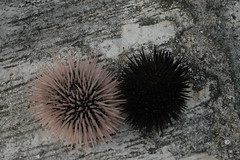
Sea UrchinsSea Urchins (Photo credit: airforcefe)

Sea urchins are some of the world’s most ubiquitous marine animals, as indeed, they can be found in nearly all corners of the planet’s oceans, as long as its main food source, algae, is present. Sea urchins are also known to prey on other invertebrates, like mussels, sponges, brittle stars, and sea cucumbers, the last two of which are from the same phylum as the sea urchin: Echinodermata. This group also includes starfish and sand dollars, and echinodermate is a Greek term that means “spiny skin.” All echinoderms share the characteristic of bi-lateral symmetry in their body composition, which becomes a five-fold symmetry as they mature.

Because its preferred source of nutrition is algae, it does have a place in a well-balanced ecosystem. However, left unchecked by predators, sea urchins can have a devastating effect on an ecosystem by obliterating macroalgae and the species that also depend on this food source to survive. Scientists call this phenomenon an “urchin barren”. Since they prefer to live in relatively shallow coastal waters, the presence of crabs, sea otters, eels, large starfish, and sea birds can help keep populations from exploding. Sea urchins are also quite popular among sushi enthusiasts, where the “roe” is collected for consumption.

Although they may seem to be rooted in one spot, sea urchins are anything but sessile. They move around by way of hundreds of tiny tube feet, just like a starfish or a sand dollar. Since their mouth is located on the underside, they spend much of their time foraging along the ocean floor, consuming algae, decaying organic matter, and other little bits of food. You may see urchins on the sea floor in colonies at times, and there is a very important reason for this. When sea urchins spawn, it takes place externally, in the water column. The male will first release its sperm, followed by a release of eggs by the female, and fertilization occurs when the eggs and sperm make contact. The more males and females there are in one consolidated area, the better chance there is to produce more embryos.

The origins of the sea urchin date back to about 450 million years ago, and have ever since been adapting to changing environments and conditions over eons to maintain their place in evolutionary history. For a creature that has no true brain, we have to take our hats off to the amazing capability for survival that the lowly sea urchin displays.

Thanks to AquaViews

Kathy Dowsett

www.kirkscubagear.com

Enhanced by Zemanta

Tuesday, October 4, 2011

Great Lakes face stresses from run-off, invaders

Rocky shore of Lake Huron taken from east of P...Image via Wikipedia

Great Lakes shorelines are becoming clogged by algae blooms fed by agricultural run-off, while invasive mussels decimate the food chain in deeper waters, an environmental group said on Tuesday.

The five lakes, which contain one-fifth of the world's fresh water and supply tens of millions of people, may be "veering close to ecosystem collapse," the report by the National Wildlife Federation said.

"Too much food is causing massive algal blooms in Lake Erie and other coastal systems, while too little food is making fish starve in Lake Huron's offshore waters," said the group's Great Lakes director, Andy Buchsbaum.

There are many problems afflicting the Great Lakes, which in other ways have grown healthier after years of pollution.

This past summer, Lake Erie was choked by toxic algae blooms up to 2 feet thick and 10 miles wide, and algae coated some Lake Michigan coastlines. Water treatment removes the toxin, at a cost, but often creates an unpleasant odor, one of the report's authors, Julie Mida Hinderer, said in an interview.

In deeper water, prolific quagga mussels have beaten out zebra mussels and colonized vast stretches of the lake bottoms, filtering out vital plankton that is the base of the lakes' food web. This has starved small fish such as alewives, bloater fish, and rainbow smelt that in turn has hurt populations of top lake predators such as whitefish and salmon.

Both mussel species are not native and arrived in the ballast water of ocean-going ships, but quagga mussels are more of a hazard because they colonize more of the lake bottom than zebra mussels.

There has been a 95 percent decline in fish biomass in Lake Huron, one of three larger lakes, in the past 15 years, according to the report. Freshwater shrimp that are key to Lake Michigan's fishery have declined by 94 percent in 10 years.

Scientists blame too much phosphorous from farm fertilizer runoff for the algae blooms, which decompose and create an oxygen-depleted "dead zone" in the Lake Erie.

Among the report's recommendations are for farmers to leave buffer zones between farmland and waterways, and better enforcement of clean water laws. Scientists are also experimenting with open water applications of a microbial agent that kills mussels, and with introducing mussel-eating fish.

The problems predate the threat to the lakes' $7 billion fishery posed by Asian carp, which authorities are desperately trying to block from migrating from the Mississippi River watershed -- though the invading carp could prove to be a benefit in that they eat an algae carpeting lake beaches.

Thanks to Andrew Stern and Reuters

Kathy Dowsett


www.kirkscubagear.com
Enhanced by Zemanta

Tuesday, January 25, 2011

Canada's Inuit gather mussels under the sea ice


A dangerous hunt for food, under the sea ice at low tide in northern Canada.

The Inuit of Arctic Canada take huge risks to gather mussels in winter. During extreme low tides, they climb beneath the shifting sea ice, but have less than an hour before the water returns.

The 500 people of Kangiqsujuaq, near the Hudson Strait, go to great lengths to add variety to their diet of seal meat, seal meat and yet more seal meat.

This settlement and a neighbouring community on Wakeham Bay are thought to be the only places where people harvest mussels from under the thick blanket of ice that coats the Arctic sea throughout the winter.

The locals can only do this during extreme low tides, when sea ice drops by up to 12m (about 40 feet), opening fissures through which the exposed seabed - and its edible riches - can be glimpsed. The best time to go is when the moon is either full or brand new, as this is when the tide stays out the longest.

Filmed for the BBC's Human Planet, they lower themselves into these temporary caverns to gather as many fat and juicy mussels as they can before the tide rushes back in.

It is a risky operation. The ice above is no longer supported by water, and it shifts and groans ominously during the harvest.

Often, says photographer Patrice Halley, who has documented this risky practice for years, a group of mussel-gatherers will have no more than a single lantern or flashlight among them.

A look-out keeps watch for the returning tide, but warning shouts cannot be too loud in case the echoes bring down the ice.

Then it's a scramble to get out before the shifting ice closes the escape hole and seawater refills the caverns.

"We all know stories of mussel hunters who didn't make it out in time. If you can't get out, you die," Mary Qumaaluk told the Human Planet team. She subsequently died in a quad bike accident.

Mussel gathering is a tradition that goes back generations in Kangiqsujuaq, on Quebec's Ungava Peninsula. But the locals say it is getting harder to find places safe enough to venture beneath the ice, which freezes later and melts earlier than it did even a few decades ago.

Thanks to the BBC and Human Planet

Kathy Dowsett

www.kirksucbagear.com
Enhanced by Zemanta