Elliott performed a scuba diving demonstration for onlookers at Long Beach's Aquarium of the Pacific, where he received the Glenn McIntyre Heritage Award for his work helping disabled children and adults through scuba therapy.
Yes, scuba therapy.
Scuba's not exactly the first thing that comes to mind when you think of rehabilitation. Music, art and even other water activities are more common tools for aiding physical and cognitive development. But in 2001, Elliott left his job as an advertising executive at the Tribune Co. and started Diveheart, a nonprofit foundation that focuses on scuba therapy.
Based in Downers Grove, Ill., a suburb of Chicago, Elliott and his team of volunteers work with people as young as eight years old who have polio, autism, brain injuries, paraplegia and amputated limbs.
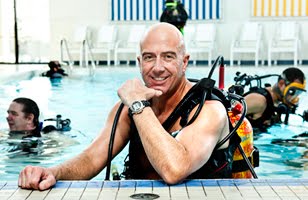
When he's working with new divers -- some of whom have never even been in water -- Elliott starts by outfitting them in full scuba gear, getting them acclimated to the equipment and explaining the concept of buoyancy and how their bodies will feel in such a different, weightless, environment. He and his volunteers demonstrate basic techniques for being underwater and guide students as they get used to having their heads submerged while using breathing apparatus. Depending on their comfort level, new divers can explore the deeper ends of the pool and swim around independently, with teachers following them. Elliott says many of his students feel comfortable during the first lesson.
"We've had people say 'On land, I feel like I'm in a cage, but when I'm underwater, I'm free,'" he says.
In addition to psychological benefits, scuba provides physical therapy by improving students' circulation and allowing oxygen to reach more parts of the body.
"Being underwater, you're in a weightless environment, so people who can't stand [on land] can stand up in the deep end of the pool," says Eric Castillo, a dive safety officer and adaptive scuba instructor at the Aquarium of the Pacific. "They can work on their muscles without the pain of gravity."
Elliott first learned to dive in 1976 when he was working as a journalist and wanted to learn the skill "just in case I ever had to interview Jacques Cousteau." He quickly developed a passion for scuba and had the idea to turn the sport into a therapy tool after witnessing the experience of his daughter, Erin. She was born partially blind, and at nine years old was mainstreamed in school with sighted children. She was constantly teased for her disability.
"I was desperate to get her involved in something to make her feel good about herself and about her visual impairment," Elliott says.
He enrolled Erin in a downhill ski program for the blind.
"She became Erin the skier, not Erin the blind kid," Elliott says. "It changed her self-esteem. She went on to excel in school, won awards, got scholarships...and I blame it on the skiing."
His daughter's progress inspired Elliott to use scuba as a tool to help people with disabilities. He traded in his media career -- and six-figure Tribune salary -- to launch Diveheart and says he now earns about $20,000 a year.
Elliott uses his skills to be a one-man marketing machine for Diveheart: He's the company's writer, promoter, advertising executive and public relations person. Almost all of the organization's teachers are volunteers. Much of what keeps the foundation running comes from donations, which pay for scuba gear repair, vehicle maintenance, office supplies, accounting work and legal advice. The foundation uses community and high school pools as its teaching facilities.
Elliott says he has downsized his lifestyle since leaving the corporate world and that his expenses are minimal. His children are grown and he's divorced. He doesn't have a house and lives in the home of a friend. When he travels, he flies on donated miles and stays with instructors in the cities where he trains. He says he has simple food and personal needs.
"I can eat PowerBars and peanut butter and be fine," says Elliott. "But usually my hosts take good care of me when I travel."
Diveheart continues to work with people in the Chicago area, and Elliott and his team also travel to start new programs. So far, they've visited more than 50 cities in the United States, Honduras, Mexico, China, Israel and Australia to show others how to use scuba as therapy.
"There are other handicap scuba associations out there," says Castillo. "But I don't know of any other organization like Diveheart that is so far-reaching."
For Elliott, there aren't enough hours in the day to reach as many people as he'd like to help. "The reason I work seven days a week is because I can't get up early enough or go to bed later to do this," says Elliott. "I'm 53; I need to make some stuff happen. And I need to make it happen now!"
Thanks to Tracey Chang
Kathy Dowsett
www.kirkscubagear.com


