Finding missing submarines or battleships is all in a day's work for Dr. Susan Langley.
An underwater archaeologist, Langley has devoted her life to the study and conservation of underwater artifacts, which she usually finds in shipwrecks.
The former Sarnian has helped excavate historic wrecks all over the world, working with UNESCO, Parks Canada, private companies, and — currently — the United States Navy.
She's also the State Underwater Archaeologist for Maryland and an adjunct professor at Johns Hopkins University in Baltimore and St. Mary's College of Maryland, teaching courses like "the history of piracy."
Much of her time is spent teaching, writing, surveying and searching for wrecks.
"We spend a lot less time diving then you would think," she said. "When you watch Discovery Channel, you may see 10 years of work squished into that one hour."
But for Langley, hard work has never been a problem. She's contributed to exhibits at the Museum of Underwater Archaeology, holds a PhD in the subject, and is currently co-authoring a book about legal issues surrounding heritage resources.
Langley said her parents first got her interested in archaeology.
"My family was always interested in history and we would go to historic sites," she said.
But it was a diver's photo on a National Geographic cover that made her consider taking her science underwater.
"That just mesmerized me that you could find these things and bring them up," she said.
There's strategy in selecting sites to survey.
"We have a huge responsibility to the taxpayer," she said. "We want them to be able to come and watch while we do it, we want to do it during part of the academic year so students can come."
Audiences aside, Langley said preserving a site is most important.
"Archaeology is a destructive science," she said. "Once you dig a site, nobody can ever come back and re-dig it. You have to do it right the first time."
It can be frustrating when looters or treasure hunters get their hands on a site, she said.
"There's no 'finders keepers.' (They're taking) it away from everybody else who's entitled to see it.
"(Artifacts) should not belong to one person."
Langley says penetration dives, where the diver enters an underwater structure, are especially dangerous. The diver risks getting lost, fragile walls collapsing, hypothermia, embolisms, and aggressive marine life like sharks or sea snakes.
Nevertheless, she has a diving career spanning three decades.
Today, she gives lectures on expedition tours, feeding the widespread fascination with underwater artifacts.
"You're touching history," she said. "They're little time capsules. There's stuff to be learned even in the mundane."
Thanks to the Sarnia
Observer
Kathy Dowsett
www.kirkscubagear.com
Friday, December 30, 2011
Wednesday, December 28, 2011
From Ad Exec to Scuba Therapist
A recent Sunday in Long Beach, Calif., found 53-year-old Jim Elliott in one of his favorite places in the world -- under water.
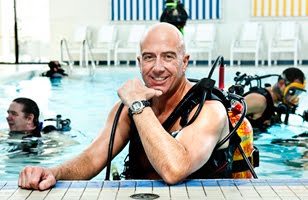
Elliott performed a scuba diving demonstration for onlookers at Long Beach's Aquarium of the Pacific, where he received the Glenn McIntyre Heritage Award for his work helping disabled children and adults through scuba therapy.
Yes, scuba therapy.
Scuba's not exactly the first thing that comes to mind when you think of rehabilitation. Music, art and even other water activities are more common tools for aiding physical and cognitive development. But in 2001, Elliott left his job as an advertising executive at the Tribune Co. and started Diveheart, a nonprofit foundation that focuses on scuba therapy.
Based in Downers Grove, Ill., a suburb of Chicago, Elliott and his team of volunteers work with people as young as eight years old who have polio, autism, brain injuries, paraplegia and amputated limbs.
When he's working with new divers -- some of whom have never even been in water -- Elliott starts by outfitting them in full scuba gear, getting them acclimated to the equipment and explaining the concept of buoyancy and how their bodies will feel in such a different, weightless, environment. He and his volunteers demonstrate basic techniques for being underwater and guide students as they get used to having their heads submerged while using breathing apparatus. Depending on their comfort level, new divers can explore the deeper ends of the pool and swim around independently, with teachers following them. Elliott says many of his students feel comfortable during the first lesson.
"We've had people say 'On land, I feel like I'm in a cage, but when I'm underwater, I'm free,'" he says.
In addition to psychological benefits, scuba provides physical therapy by improving students' circulation and allowing oxygen to reach more parts of the body.
"Being underwater, you're in a weightless environment, so people who can't stand [on land] can stand up in the deep end of the pool," says Eric Castillo, a dive safety officer and adaptive scuba instructor at the Aquarium of the Pacific. "They can work on their muscles without the pain of gravity."
Elliott first learned to dive in 1976 when he was working as a journalist and wanted to learn the skill "just in case I ever had to interview Jacques Cousteau." He quickly developed a passion for scuba and had the idea to turn the sport into a therapy tool after witnessing the experience of his daughter, Erin. She was born partially blind, and at nine years old was mainstreamed in school with sighted children. She was constantly teased for her disability.
"I was desperate to get her involved in something to make her feel good about herself and about her visual impairment," Elliott says.
He enrolled Erin in a downhill ski program for the blind.
"She became Erin the skier, not Erin the blind kid," Elliott says. "It changed her self-esteem. She went on to excel in school, won awards, got scholarships...and I blame it on the skiing."
His daughter's progress inspired Elliott to use scuba as a tool to help people with disabilities. He traded in his media career -- and six-figure Tribune salary -- to launch Diveheart and says he now earns about $20,000 a year.
Elliott uses his skills to be a one-man marketing machine for Diveheart: He's the company's writer, promoter, advertising executive and public relations person. Almost all of the organization's teachers are volunteers. Much of what keeps the foundation running comes from donations, which pay for scuba gear repair, vehicle maintenance, office supplies, accounting work and legal advice. The foundation uses community and high school pools as its teaching facilities.
Elliott says he has downsized his lifestyle since leaving the corporate world and that his expenses are minimal. His children are grown and he's divorced. He doesn't have a house and lives in the home of a friend. When he travels, he flies on donated miles and stays with instructors in the cities where he trains. He says he has simple food and personal needs.
"I can eat PowerBars and peanut butter and be fine," says Elliott. "But usually my hosts take good care of me when I travel."
Diveheart continues to work with people in the Chicago area, and Elliott and his team also travel to start new programs. So far, they've visited more than 50 cities in the United States, Honduras, Mexico, China, Israel and Australia to show others how to use scuba as therapy.
"There are other handicap scuba associations out there," says Castillo. "But I don't know of any other organization like Diveheart that is so far-reaching."
For Elliott, there aren't enough hours in the day to reach as many people as he'd like to help. "The reason I work seven days a week is because I can't get up early enough or go to bed later to do this," says Elliott. "I'm 53; I need to make some stuff happen. And I need to make it happen now!"
Thanks to Tracey Chang
Kathy Dowsett
www.kirkscubagear.com
Elliott performed a scuba diving demonstration for onlookers at Long Beach's Aquarium of the Pacific, where he received the Glenn McIntyre Heritage Award for his work helping disabled children and adults through scuba therapy.
Yes, scuba therapy.
Scuba's not exactly the first thing that comes to mind when you think of rehabilitation. Music, art and even other water activities are more common tools for aiding physical and cognitive development. But in 2001, Elliott left his job as an advertising executive at the Tribune Co. and started Diveheart, a nonprofit foundation that focuses on scuba therapy.
Based in Downers Grove, Ill., a suburb of Chicago, Elliott and his team of volunteers work with people as young as eight years old who have polio, autism, brain injuries, paraplegia and amputated limbs.
When he's working with new divers -- some of whom have never even been in water -- Elliott starts by outfitting them in full scuba gear, getting them acclimated to the equipment and explaining the concept of buoyancy and how their bodies will feel in such a different, weightless, environment. He and his volunteers demonstrate basic techniques for being underwater and guide students as they get used to having their heads submerged while using breathing apparatus. Depending on their comfort level, new divers can explore the deeper ends of the pool and swim around independently, with teachers following them. Elliott says many of his students feel comfortable during the first lesson.
"We've had people say 'On land, I feel like I'm in a cage, but when I'm underwater, I'm free,'" he says.
In addition to psychological benefits, scuba provides physical therapy by improving students' circulation and allowing oxygen to reach more parts of the body.
"Being underwater, you're in a weightless environment, so people who can't stand [on land] can stand up in the deep end of the pool," says Eric Castillo, a dive safety officer and adaptive scuba instructor at the Aquarium of the Pacific. "They can work on their muscles without the pain of gravity."
Elliott first learned to dive in 1976 when he was working as a journalist and wanted to learn the skill "just in case I ever had to interview Jacques Cousteau." He quickly developed a passion for scuba and had the idea to turn the sport into a therapy tool after witnessing the experience of his daughter, Erin. She was born partially blind, and at nine years old was mainstreamed in school with sighted children. She was constantly teased for her disability.
"I was desperate to get her involved in something to make her feel good about herself and about her visual impairment," Elliott says.
He enrolled Erin in a downhill ski program for the blind.
"She became Erin the skier, not Erin the blind kid," Elliott says. "It changed her self-esteem. She went on to excel in school, won awards, got scholarships...and I blame it on the skiing."
His daughter's progress inspired Elliott to use scuba as a tool to help people with disabilities. He traded in his media career -- and six-figure Tribune salary -- to launch Diveheart and says he now earns about $20,000 a year.
Elliott uses his skills to be a one-man marketing machine for Diveheart: He's the company's writer, promoter, advertising executive and public relations person. Almost all of the organization's teachers are volunteers. Much of what keeps the foundation running comes from donations, which pay for scuba gear repair, vehicle maintenance, office supplies, accounting work and legal advice. The foundation uses community and high school pools as its teaching facilities.
Elliott says he has downsized his lifestyle since leaving the corporate world and that his expenses are minimal. His children are grown and he's divorced. He doesn't have a house and lives in the home of a friend. When he travels, he flies on donated miles and stays with instructors in the cities where he trains. He says he has simple food and personal needs.
"I can eat PowerBars and peanut butter and be fine," says Elliott. "But usually my hosts take good care of me when I travel."
Diveheart continues to work with people in the Chicago area, and Elliott and his team also travel to start new programs. So far, they've visited more than 50 cities in the United States, Honduras, Mexico, China, Israel and Australia to show others how to use scuba as therapy.
"There are other handicap scuba associations out there," says Castillo. "But I don't know of any other organization like Diveheart that is so far-reaching."
For Elliott, there aren't enough hours in the day to reach as many people as he'd like to help. "The reason I work seven days a week is because I can't get up early enough or go to bed later to do this," says Elliott. "I'm 53; I need to make some stuff happen. And I need to make it happen now!"
Thanks to Tracey Chang
Kathy Dowsett
www.kirkscubagear.com
Monday, December 19, 2011
Scuba diving on a shoestring
It's certainly no secret to scuba diving enthusiasts that seeing the spectacular sights beneath the ocean's surface isn't typically considered a shoestring endeavor. If you're willing to consider some minor tweaks to the typical dive vacation, however, spotting more underwater scenery for your money is definitely possible. Try these thrifty travel tips to experience a world-class scuba getaway for a song.
Discounts: In Pompano Beach, Florida, a number of notable wreck and reef diving opportunities are available. Divers can score great deals here during the month of June, which has been designated as a learning month for new divers. Many dive operators and resorts offer great package prices during this time. Additionally, at The Scuba Club in Florida's West Palm Beach - a sort of country club for the dive crowd - members receive preferred pricing discounts of up to a full third off regular excursion rates. To keep track of other dive deals and locate certified equipment facilities from your smart phone, PADI - the Professional Association of Dive Instructors - has a mobile app available for download on their website.
Transportation: Boat charters to off-shore sites can add significantly to the overall cost of your vacation. Consider incorporating more shore excursions into your underwater adventure getaway to maximize your dive dollars. According to Terri Huber, a dive travel wholesale specialist with Deep Blue Adventures, one of the best places to accomplish this is the Caribbean island of Bonaire, which is synonymous with shore diving. According to Huber, numerous resort packages there offer multi-bedroom apartments for mid-sized dive groups which include kitchen access, daily breakfast, vehicle, tank refills and unlimited shore diving starting at roughly $110 per person per day.
Temperature: Since many people prefer tropical temperatures, heading to colder waters can shave significant dollars off the cost of a scuba trip for more serious dive enthusiasts. Matt Reider, a PADI-certified master scuba diving trainer and founder of the Canuck Abroad travel Web site, points to Vancouver Island off the west coast of Canada for some of the best diving in the world, much of it accessible from the shoreline. Roughly 5 minutes from the city of Victoria says Reider, divers can hit the water to explore wolf eels, seals, sea lions, giant octopus and more. Once you have your dry suit and other gear, the only cost for this activity is a tank of air!
Theriault is the best-selling co-author of the book "10,001 Ways to Live Large on a Small Budget," and founder of TrekHound.com, a website for independent travelers. She also founded TheLessonMachine.com, a website for teachers.
Kathy Dowsett
www.kirkscubagear.com
Saturday, December 17, 2011
What It's Like ... To Be the World's Oldest Diver
The World's Oldest Diver::::Norman Lancefield
I’m 91 and have been diving with the same gear since 1970. Like me, it’s still going strong after more than 500 dives. My hips don’t stick out far enough, so I can’t wear a weight belt; instead, I rely on a harness and I make my own weights with melted lead shaped in loaf tins. This setup has worked for me in Malta, Mexico, Turkey and my favorite destination, the Gulf of Aqaba in the Red Sea. I have swum with sharks and dolphins, but at my age you don’t need obvious excitement. Even a hermit crab can be thrilling — they’re funny creatures, living in second-hand seashells.
Diving isn’t a dangerous sport; it is a hazardous sport and my goal is to avoid the hazards. A buddy helps me into the water, but after that, once I’m in I do fine.
I don’t do strong currents — those days are long gone. I don’t go too deep either. I’m not as physically fit as I used to be, but that’s why I like diving: I tell anyone looking to take up the sport that you don’t need to be an Olympic swimmer. I’m noticeably slow in the water, but I still swim 500 meters three times a week.
Because of this, I could swim all day if I had to. It’s important to me that I keep up with my buddies in the Barry Sub Aqua Club here in Wales. I also make a point of testing my gear regularly. It sits in a closet all winter, so I kit up in a local pool before each season. I’d rather find problems when I am only six feet deep.
Only once have I been scared in the water. My mask flooded completely — I had placed part of the seal atop my hood. I lit my torch, spun wildly in a circle and realized I had lost my buddy. But I surfaced after one minute and returned to the boat. There was my buddy waiting for me.
It’s important for divers — of any age — to know when to say no. You don’t want to put a buddy at risk. I had a mild attack of the flu 18 months ago, and had to sit out on a planned dive. But for the most part, I stay fit. As long as I can keep going and not be too much nuisance to my buddy, I will keep diving.
Thanks to Norman Lancefield and Scuba Diving
Kathy Dowsett
www.kirkscubagear.com
Thursday, December 15, 2011
Cold Water Diving
As winter starts to set in and the temperature drops there is more that we need to bear in mind before each dive.
I certainly don’t want to put anyone off but diving in cold water creates a new set of challenges that need to be prepared for before actually going diving. Every piece of equipment that you use needs to be considered, checked and corrected/upgraded if it isn’t up to scratch. As always your kit is life support equipment, if it fails or isn’t up to the job you put your life in danger every time you get in the water. This is no more true than when we, as divers, encounter extreme conditions.
If you think about it, its not just the obvious kit either like your regulators and thermal protection. What about the battery status of your dive computer? The cold can seriously affect the chemical reactions within the battery, reducing the performance of the battery in cold conditions. When you check it prior to the dive the battery will probably be nice and warm after you’ve travelled to your dive location but once you’ve jumped in and shocked it with the temperature change its not uncommon for the dive computer to report a low battery status and possibly even shut down as a result of insufficient current.
All these little things can massively affect the outcome out your dive, if you even get in. So what are some of the main things to remember?
Regulators
Your regulators should be cold water certified when diving in water temperatures below 10 degrees Celsius
Avoid excessive testing on the surface, especially using the purge button as this causes significant temperature drop in the first and second stages which can allow any moisture to freeze.
Avoid breathing from or exhaling through your regulators whilst on the surface to prevent exhaled moisture freezing on the second stage components.
Reduce the load on your first stage by avoiding excessive breathing and inflating your BCD / wing / drysuit whilst inhaling.
Thermal Protection
Proper thermal protection is essential with a drysuit and appropriate thermal layers being an must, especially if you want to be in the water for any length of time. The best way to protect yourself is to layer up, ideally at least three. Three layers provides a base layer which is usually a fast wicking material to draw moisture away from the skin, then your primary insulation layer with your outer layer as the drysuit. Obviously the suit you wear will affect the other two layers as a neoprene drysuit will provide better thermal protection than a membrane suit. There are alternatives that break this mould such as the Waterproof D1 Hybrid drysuit which uses a non-compressible layer to maintain the air space around your body and also the Fourth Element Halo 3D undersuit which uses similar technology in key areas.
It also goes without saying that you need to protect your extremities as well. Your hands and feet can quickly get cold which in turn starts to lower your core temperature as the cold blood returns to your heart. The body tries to counter this by restricting the flow to these cold areas to maintain core temperature but its definitely good practice to wear high quality, well fitting and thick gloves in cold water. Don’t forget your head as well, up to a third of your body heat can be lost through your head so make sure its well protected with a good thick hood.
The Little Things
As mentioned before the cold can affect your dive computer, reducing the performance of the battery and possibly shutting it down. The same goes for any other battery operated devices like your torch, make sure you carry a small spare in case your main fails.
Try to avoid leaving your cylinder laying on the cold floor and prevent even the smallest drop of water getting into the regulators when fitting them.
With all the extra layers on you’re likely to need extra weight, make sure you perform a buoyancy check before you set off on your dive. Being light towards the end of the dive is dangerous.
Thick gloves make donning and doffing fins harder, similarly pressing and releasing clips is the same. Make sure you are able to operate all of your releases comfortable and safely without the need to remove your gloves. If you can’t handle a vital clip underwater because of your 5mm or thicker gloves things could get a bit sticky.
Generally be prepared for the cold. If you lose or need to replace your mask for whatever reason it can be a real shock to the system to have that cold water on the face and can cause divers to lock up, struggle to breathe or even panic.
If you’re diving in a fresh water lake and the temperature is low enough for ice to form on the surface be sure to reel off from your entry point so that you always now where a safe exit point is.
At the end of the day the idea is to be safe, plan your dive and stick to it. If you do that and bear in mind the conditions it should lead to a very enjoyable (though chilly) dive.
Thanks to Simply Scuba
Kathy Dowsett
www.kirkscubagear.com
Tuesday, December 13, 2011
German submarine U-352
German submarine U-352 was a Type VIIC U-boat of the German Kriegsmarine during World War II.
1st patrol
U-352 left Kiel on 15 January 1942, and arrived at Bergen on the 19th. She left the next day and patrolled south of Iceland without success before sailing to her new home port at Saint-Nazaire by 26 February.
2nd patrol
U-352 left St. Nazaire on 7 April 1942 and sailed across the Atlantic to the coast of the north-eastern United States. There on 9 May 1942, she was sunk by depth charges from the US Coast Guard cutter USCGC Icarus, south of Morehead City, North Carolina, in position 34°21′N 76°35′WCoordinates: 34°21′N 76°35′W. Fifteen of the crew were lost, but 33 survived, and spent the remainder of the war as prisoners of war.
Dive site
The U-352 lies in about 100 feet (30 m) of water, and sits at a 45-degree list to starboard. This wreck is a popular scuba diving spot for advanced divers. A replica of the wreck is on display at the North Carolina Aquarium at Pine Knoll Shores.
Heinz Richter
Heinz Karl Richter, a Maschinengefreiter (equivalent of a Fireman 3rd Class) who survived the sinking, was found living in Canada and was interviewed for Discovery Channel's special coverage of U-352. He said that Captain Rathke was obsessed with receiving a Knight's Cross of the Iron Cross medal for sinking 100,000 tonnes worth of enemy ships. Richter said that the captain's obsession eventually led to recklessness, ultimately resulting in the ship's sinking. Richter also said he was the last man out of the boat before it sank; those still on board were already dead, or perished in the boat as it sank.
Video of U-352, sunk May 9, 1942, taken in July, 2011 while diving with Olympus dive charters located in Morehead, NC.
Lying on the bottom in approx. 100 ft of water 30+ miles from shore, heavy seas often prevent access to divers.
Thanks to Wikipedia for the article and Brian Spilsbury for the video.
Kathy Dowsett
www.kirkscubagear.com
Sunday, December 11, 2011
Be a smart diver
Join efforts to preserve dive experiences for future generations of divers by protecting and supporting your national marine sanctuaries.
Sharpen your skills. Mastering buoyancy control and streamlining your equipment will help minimize the risk of entanglement or accidental disturbance of the bottom. Even the slightest damage can permanently alter an entire ecosystem or historical shipwreck site.
Learn the proper techniques for shipwreck diving. When diving shipwrecks, always know the orientation of the wreck site and only enter the wreck if specifically trained to do so.
Be familiar with kelp diving procedures. Always swim below the surface of a kelp canopy and navigate with your compass. Don't panic or thrash around if entangled, slowly remove the kelp or have your buddy gently untangle it for you.
Respect marine wildlife. Enjoy viewing marine mammals and wildlife from a safe distance. Should you encounter marine mammals and observe nervous behavior, back away.
Don't collect underwater souvenirs - leave them behind for others to enjoy. Resist the temptation to collect shells, rocks or other underwater artifacts, because they provide homes for sea creatures. Additionally, removal of any historical artifacts is regulated by law.
Be a marine debris crusader. Once you finish your dive, make sure to carry away any trash you - and others - may have left behind. Beach litter poses a significant threat to the health and survival of marine organisms, which can swallow or get tangled in beverage containers, plastic bags, six-pack rings and other debris.
Thanks to National Marine Sanctuaries and Bing
Kathy Dowsett
www.kirkscubagear.com
Subscribe to:
Posts (Atom)